

Bluebottle Jellyfish Treatment and Prevention

Going to the beach is a favourite pastime among Australians.
But like most Australian pastimes, the beach is littered with native fauna that can inflict bites and stings ranging from the painful to the fatal.
One such creature is the Bluebottle jellyfish, or Indo-Pacific Man o'War, an unsurprisingly blue-coloured siphonophore that is commonly encountered during summer on the eastern coast of Australia.
Continue reading for more information about the Bluebottle jellyfish and how to treat and prevent their stings, which can cause intense, long-lasting pain and even allergic reactions.
We also cover jellyfish and other marine stings in our first aid courses:
Head to our website to find a training location near you today.
As we mentioned earlier, the Bluebottle jellyfish is a siphonophore.
As such, it is not a single animal, but a colony of four highly modified polyps that depend on one another for survival:
The Bluebottle float has aerodynamic properties and is often carried by warm currents to more temperate waters.
As such, they are commonly encountered during summer on the Australian east coast.
They are also regularly spotted on exposed ocean beaches after being washed ashore by strong onshore north easterly winds.
It is important to remember, as Bluebottles are common in non-tropical areas, jellyfish stings in tropical waters should be treated as a suspected Box jellyfish or Irukandji sting.
Humans can sustain a sting if they come into contact with the stinging cells on the Bluebottle's predatory tentacles, which contain a toxic mix of phenols and proteins.
Symptoms of a Bluebottle jellyfish sting include:

In the event of a Bluebottle jellyfish sting:
*Ensure the water will not scald the casualty
We run certified First Aid courses throughout all major Australia citys. Find a location near you.
To prevent a Bluebottle jellyfish sting:
Bluebottle jellyfish have stinging cells that contain a potent mix of phenols and proteins and can cause intense pain and redness upon contact with human skin.
If you are stung by a Bluebottle, you can usually treat the symptoms by immersing or covering the affected area in hot water. Wrapped ice packs can also provide relief.
You should seek medical attention if the affected area is significant, the pain does not cease, or you begin experiencing an allergic reaction.
For more information on treating Bluebottle and other marine stings, enrol in one of our first aid courses:
Head to our website to find a training location near you today.
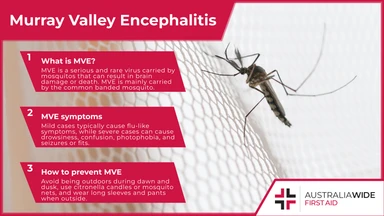
December 9, 2022
Murray Valley encephalitis is a serious and rare virus carried by mosquitos that can result in brain damage or death. The best way to prevent infection by Murray Valley encephalitis is to protect yourself from mosquito bites.
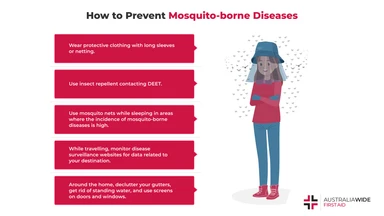
December 2, 2022
Mosquito-borne diseases are those acquired through mosquito bites. Though mosquito-borne diseases have a worldwide distribution, they pose a significant risk in tropical holiday destinations like Bali, where Aedes aegypti mosquitos are in abundance.
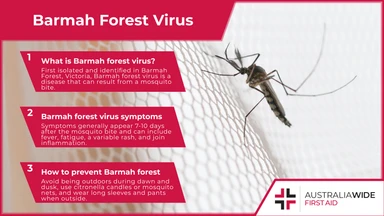
November 30, 2022
Barmah Forest virus is a mosquito-borne diseases characterised by fatigue, joint pain, and variable rashes, which can persist for several months. The best way to prevent infection by Barmah Forest virus is to protect yourself from mosquito bites.